
Special issue: Applied Mechanics
Image

The sustainable exploitation of these energy resources, in a highly competitive environment, requires the combined implementation of expertise and innovative solutions founded on high-quality scientific research. This requirement is also relevant to IFPEN’s long-standing fields, which have to address cost and environmental impact issues.
With this in mind, Applied Mechanics researchers are working to build on their knowledge — particularly in offshore oil and gas production — through scientific challenges whose resolution combines experimentation (including large-scale), modeling and numerical simulation in a number of fields: complex flows, hydrodynamics, aerodynamics, fluid structure couplings, non-linear behavior of materials and structures.
In this issue, we look at examples of progress made in the field of computational mechanics serving new energy technologies.
We hope that you enjoy this issue.
Laurent Cangémi, Deputy Scientific Director, Applied Physical Chemistry and Mechanics Division
Fichier
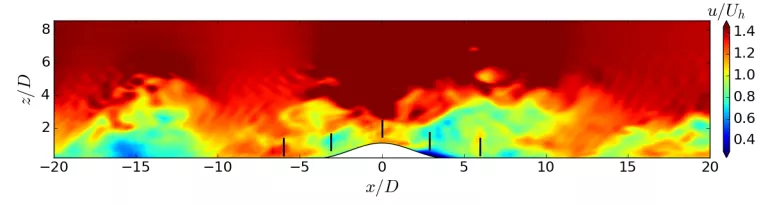
The development of wind farms requires the optimal placement of wind turbines in relation to each other in order to maximize overall production.