
The use of renewable carbon-based biofuels is a solution aimed at reducing the climate impact of combustion engine vehicles. However, the diversity of potential biomass sources requires a characterization of any potential pollutants contained within the biomass that may prove harmful from an environmental or technical point of view.
With this in mind, an investigation of the inorganic contaminants contained in different sources of bioethanol was conducted, in partnership with Alicante University(1), using atomic spectrometry techniques (ICP/OESa and ICP/MSb). It covered a broad range of bioethanols used as a fuel base, but also in the petrochemicals sector. Across all of the samples analyzed, the contents measured were systematically comparable or indeed below those of a commercial gasoline (< mg/kg).
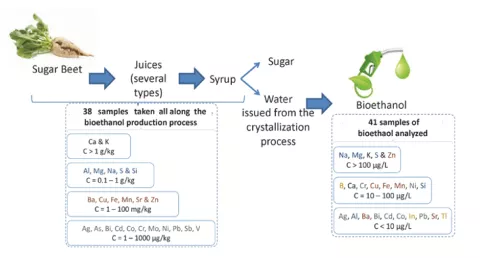
The analyses were conducted throughout the manufacturing process in order to identify the origin of these contaminant traces in bioethanol derived from beetroot(2). It turns out that most of the metals present in the end product were already present in the original biomass (figure) rather than the result of process-induced contamination. Above all, an improvement is observed at the distillation stage, which is particularly effective when it comes to eliminating these contaminants, with concentrations reduced by a factor of 10,000 in bioethanol!
Finally, complementary research using isotope analysis of ultra-trace lead (Pb)(3) demonstrated that it was possible to identify the resource employed to produce the bioethanol: wheat, wine, beetroot, cane or non-food residues (2nd generation).
a - Optical emission spectrometry combined with ICP (Inductively Coupled Plasma)
b - Mass spectrometry combined with ICP
(1) C. Sánchez, C.-P. Lienemann, J.-L. Todolí, Spectro Chimica Acta Part B, 124, (2016), 99-108.
DOI : 10.1016/j.sab.2016.08.018.
(2) C. Sánchez, C.-P. Lienemann, J.-L. Todolí, Fuel Processing Technology, 173, (2018), 1-10.
DOI : 10.1016/j.fuproc.2018.01.001
(3) C. Sánchez, E. Bolea-Fernández, M. Costas- Rodríguez, C.-P. Lienemann, J.-L. Todolí, F. Vanhaecke, J. Anal At. Spectrom, 33, (2018), 481-9.
DOI : 10.1039/c8ja00020d